

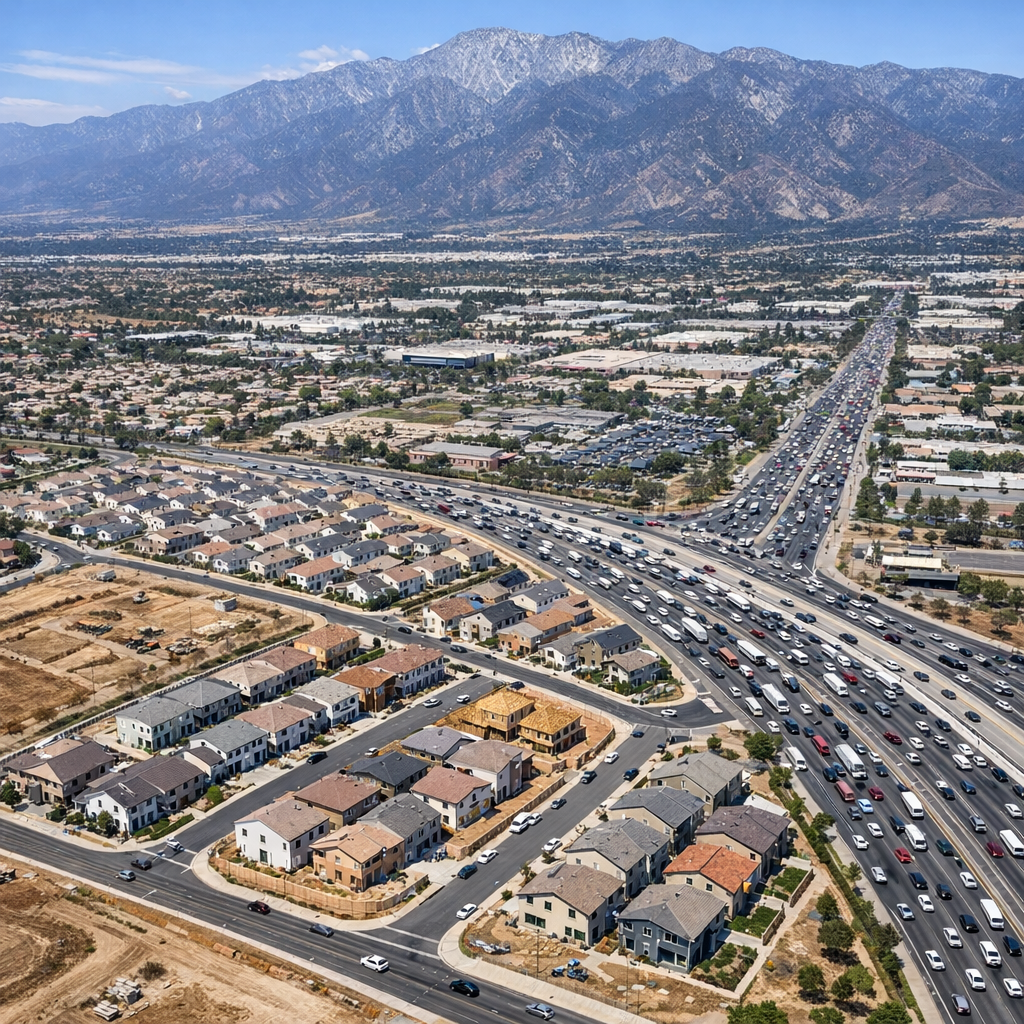
Rancho Cucamonga is experiencing significant growth, with approximately 10,000 apartment units planned or approved throughout the city. Many of these projects are large multi-story developments, commonly referred to by residents as “stack and pack housing.” The scale and pace of this development have raised serious concerns across District 2 and throughout the city.
Foothill Boulevard—historic Route 66—is already one of the most congested corridors in Rancho Cucamonga. Many new apartment complexes are being built directly along or near Foothill Boulevard. As these units are completed, thousands of additional vehicles will enter local streets daily. Residents consistently raise concerns such as increased traffic congestion, longer commute times, strain on intersections and signals, emergency vehicle access delays, and pressure on water, sewer, and utility systems.
Before approving high-density housing, city leadership must ask: Is the infrastructure truly ready? Infrastructure should lead development—not chase it.
Most current apartment projects are four stories. However, a seven-story development has been proposed at the northwest corner of Spruce Avenue and Red Oak Street. Height matters. When new height benchmarks are approved, they often become precedent for future projects. Residents reasonably ask: “If seven stories is acceptable today, what becomes acceptable tomorrow?” City planning decisions shape the character of Rancho Cucamonga for decades. These decisions deserve careful public discussion.
The Grove and Foothill project sits near the boundary between Rancho Cucamonga and Upland. As development continues across Rancho Cucamonga, residents are increasingly asking an important question: Can the city’s infrastructure keep up with the pace of growth? From traffic congestion on major corridors to long-term planning for roads, utilities, and public services, the conversation is expanding beyond individual projects to the broader impact on daily life.
City Council candidate David VanGorden emphasizes the importance of aligning growth with the city’s ability to support it. He states, “Growth without infrastructure is not progress.” VanGorden is running for Rancho Cucamonga City Council against incumbent Kristine Scott.
As development continues across Rancho Cucamonga, residents are beginning to ask how growth may impact public safety resources, including police, fire, and emergency response services. From response times to preparedness for large-scale emergencies, the conversation is expanding as more people consider how increasing population and new housing developments may affect the city’s ability to respond effectively.
David VanGorden says these concerns are part of a broader discussion about planning and long-term sustainability. He encourages residents to take a closer look at the proposed expansion of the Etiwanda Heights development plan, saying the issue highlights broader questions about infrastructure, transparency, and long-term planning in the city.
In 2019, the City of Rancho Cucamonga approved the Etiwanda Heights Neighborhood and Conservation Plan, which established a framework for approximately 3,000 homes while preserving significant open space in the area. More recently, a proposal has been introduced that could increase that number to approximately 6,000 homes, a change that has prompted questions from residents across Rancho Cucamonga.
As Rancho Cucamonga continues to experience growth and new development, residents are beginning to ask a practical question: How is quality of life being measured as the city expands? The question comes as planning discussions and long-term vision documents continue to emphasize growth, development, and a forward-looking future for the city.
According to the City of Rancho Cucamonga’s General Plan, growth and development are often described using terms such as “vibrant,” “connected,” and “forward-looking,” which has led some residents to ask how those goals are reflected in everyday life. “Growth is expected in any successful city,” said David VanGorden, candidate for Rancho Cucamonga City Council, District 2. “But residents are asking how that growth is being measured and whether it aligns with their day-to-day experience.”
As Rancho Cucamonga continues to grow, residents are experiencing increased traffic congestion and longer commute times. City Council candidate David VanGorden says these concerns highlight the need for infrastructure planning that keeps pace with development. From longer commute times to heavier traffic along key routes such as Foothill Boulevard and surrounding areas, the impact of growth is becoming more visible in everyday life.
As the city continues to expand, it is crucial for city officials and residents to engage in open dialogues about balancing growth with infrastructure development to ensure a sustainable and high-quality living environment for all.